

.jpg)


A Win for Pesticide Corporate Image Washing

I’m grateful local resources like natural history museums exist to educate and give context about the natural world, human culture, and science in a way that can’t be replicated in a classroom, in books, or online. I mean where else can you see a 100-million-year-old life-sized dinosaur!

To finance their core activities, corporate funding is a fact of life for nonprofit such as museum. Corporations often have the deepest pockets and are always looking for ways to glow up their image. In my role as founder, funder, and leader of a niche school for high support neurodiverse kids for years I had firsthand experience with the struggle to get the donations and public recognition needed to fulfill our mission.

The award-winning Fernbank Museum of Natural History just raised $27 million dollars to upgrade their exhibits. One of the new permanent exhibits called the Orkin Discovery Zone, is an interactive experience highlighting biodiversity in wildlife. Orkin is the flagship brand of Rollins, the largest privately owned pest control company in the US worth $17.5 billion dollars. They’re headquartered in Atlanta less than a couple miles from where I live which is a couple miles from the museum. What an image washing victory for a company that makes money exterminating insects to get their signature brand logo on an educational exhibit highlighting insects!
Pesticide companies
🐜🌱🦎kill life - insects, plants, and other wildlife
🦋directly affected the 22% butterfly drop off from 2000 to 2020
‘🐝play a large role in the plummeting native bee populations
🪲contribute to the ongoing beetles decline – the largest insect category that includes fireflies
The pesticide industry continues marching forward to destroy biodiversity where we live.
✅Their lobbyists protect them from being held responsible for the damage they are doing – Georgia is one of three states with pesticide liability shield laws that ban local municipalities from passing stricter pesticide regulations than the EPA.
✅Their public relation and philanthropy efforts corporate community wash to obscure their core business of killing the invertebrates that E.O. Wilson famously called "the little creatures that run the earth" in his speech at the 1987 opening of the invertebrate exhibit at the National Zoological Park in D.C.

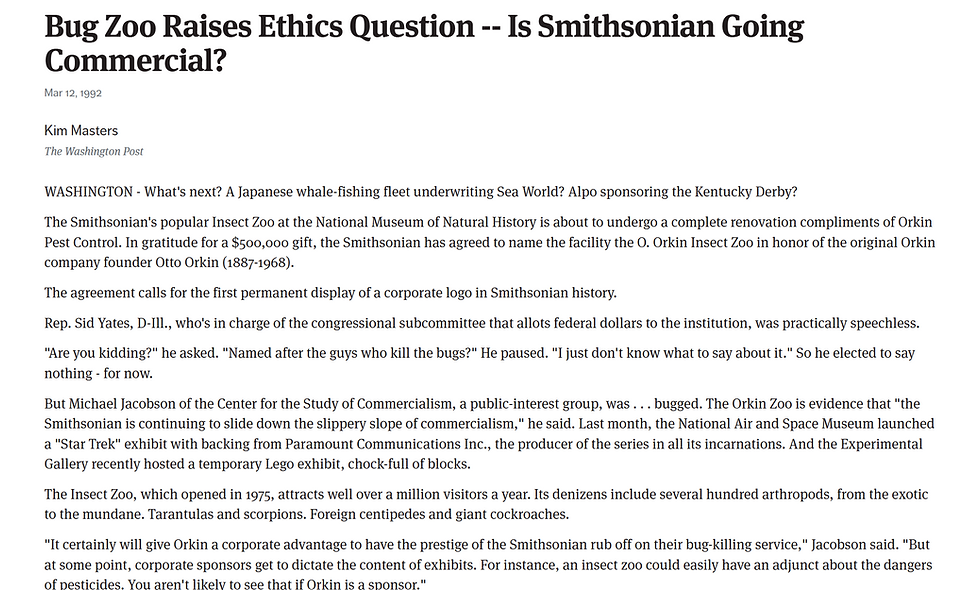
Orkin was a pioneer in leveraging corporate donations to nonprofits. The famous Insect Zoo at the Smithsonian Museum opened in 1976, was renovated in 1992, and reopened in 1993 as the O. Orkin Insect Zoo with a $500,000 donation from Orkin. We lived in D.C. at the time and the opening was a hot controversial topic.
In a Washington Post article a public-interest group noted the corporate image washing aspect of the gift: "it gives Orkin a corporate advantage to have the prestige of the Smithsonian rub off on their bug-killing services”. A letter to the editor said it was "like naming a cancer clinic after a tobacco company" (which seems beyond the pale until your realize the Duke Cancer institute may not be named after a company but is named after the founder of the modern tobacco industry)

The main issue was the donation to renovate the Smithsonian marked the first time a Smithsonian exhibition was named after a corporate entity and featured a corporate logo at its entrance. It was a brilliant PR investment for Orkin of what would be a little more than $1 million dollars today and a debatably poor decision for the Smithsonian because it set a precedent for other questionable philanthropy branding since then. It also gave Orkin a sneaky way to sell their services by helping to create a new interactive section in the renovated exhibit showing the interior of a house where insects might be - which you undoubtedly wouldn't see if Orkin wasn't a sponsor.

Some non-profit organizations such as Xerces have taken a stand against accepting money from sources that don’t align with their core mission including pesticide companies. This makes sense. Xerces Society was formed 55 years ago to protect butterflies and is named after an extinct butterfly. It's also an organization E. O. Wilson mentioned in his 1987 speech encouraging invertebrate conservation! If you have a minute, it’s worth reading the Xerce’s statement HERE to see what living your truth means as a science based non-profit. In short, Xerces will not accept money from companies with products harming the very animals they are protecting. The pesticide market is booming and edging towards being worth $100 billion dollars in the US. Xerces is committed to seeking out partners with shared goals of solving the biodiversity crisis - and pesticides companies by definition do not share this goal.
Xerces makes clear they will not participate in being a cover to help these companies use their philanthropy to wash their hands of the environmental damage they are doing. They points out that pesticide companies often fund universities and nonprofits such as museums so they can be perceived as part of the solution when the damage they are doing is part of the problem. They build brand awareness and positive public relations by aligning themselves with community education and science. Rollins largesse appears to come with naming rights – such as the top tier Rollins School of Public Health associated with Emory University only a short walk from my home. The PR long game is more obvious when you learn the pesticide companies also spend money to discredit research about the harm their company is doing and lobbying to make sure they can continue to sell their products and services to the public.
I’m not naïve about the reality of how philanthropy works and at the same time am conflicted by the ethics of companies using the same money they make harming our world to help our world in some way. Does it really matter if its corporate guilt or image washing designed to distract from the core business of a company? I admire Xerces for not dancing around their position or focusing on the positive impact of the money. They hit at the heart of the situation: “Pesticides are major drivers of insect decline and endangerment. "Pesticides—properly known as biocides—are designed to kill, with insecticides specifically targeting insects. Unfortunately, most insecticides do not just harm their target species. They can harm all insects, including pollinators and aquatic insects, as well as countless other vital invertebrates.”

Maybe pesticide companies need to remain silent partners with educational organizations if they sincerely feel guilty and need to community wash away their sins. My discomfort with the family friendly Orkin Discovery Zone includes Orkin’s own social media ad campaign that highlights their sponsorship to reaffirm the idea that seeing bugs in a museum is good but you don’t want them where you live. When they say you don’t want bugs in your home, this means killing insect life in the ecosystem outside the home since by the pest industry's own account only 1% of residential pesticide accounts are indoor-only! (~Half of the accounts are outdoor only and 60% are indoor and outdoor).
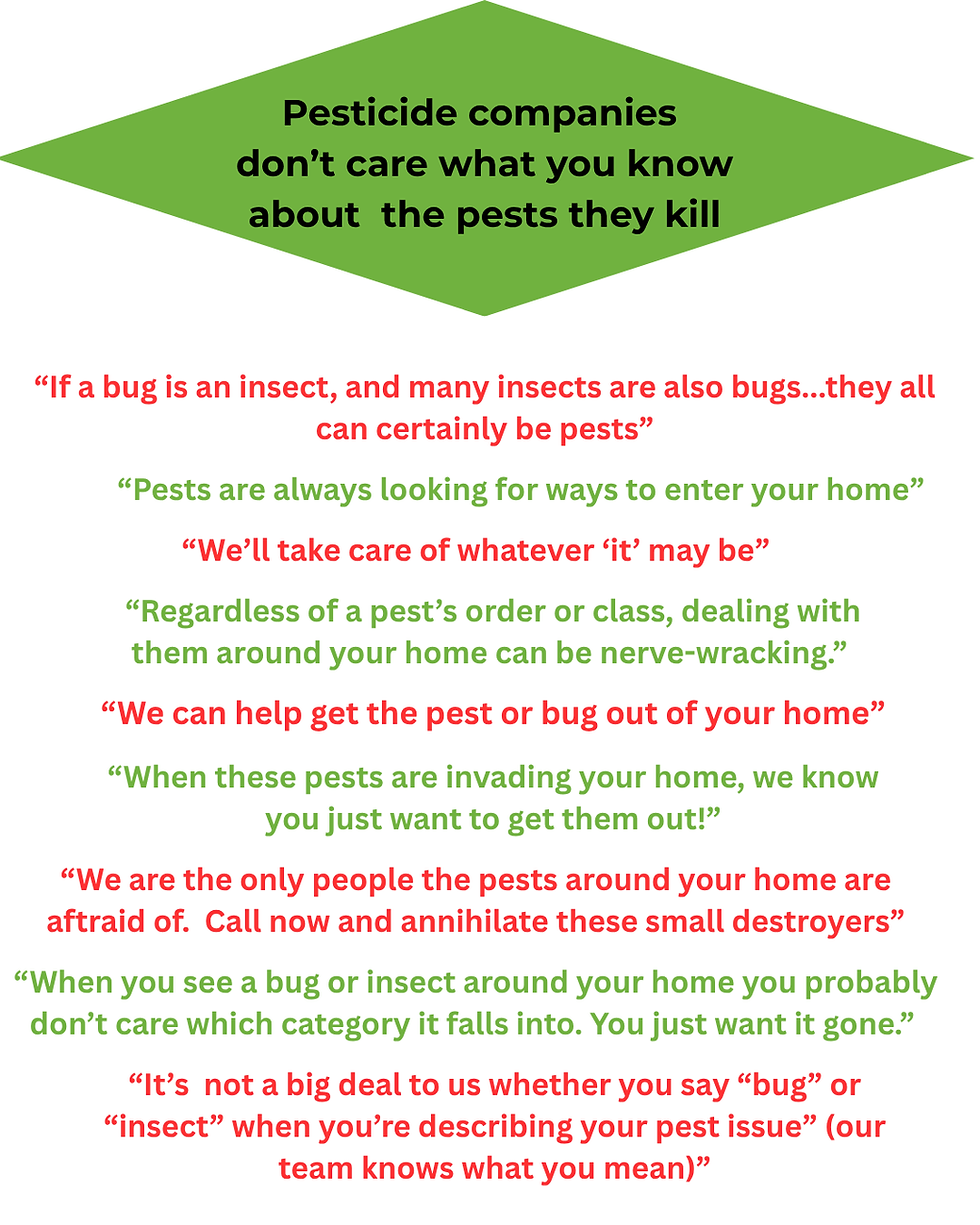
Pesticide companies like Orkin tend to use the term bug to describe insects and not in a cute snug as a bug in a rug sort of way. The goal seems to be to make insects scary and annoying and the word insect just doesn’t pack the same emotional punch that the word bug carries with it. (The Fernbank exhibit itself generally explains what a bug and an insect are)
Pesticide companies use evocative negative emotional descriptions of insects and conflate the differences between insects, bugs, and pests such as this example from one company that is typical of the industry and calls insects creepy crawlers, frustrating and nerve-racking and encourages folks to call them to protect their home from the scary marauders! Again, only 1% of pest control is indoor-only so this is a sales strategy based on instilling a fear of insects wanting to live inside our home instead of more suitable habitats outside our home. It's justification for drenching yards in pesticides.
Sponsoring this kind of exhibit is consistent with pesticide companies using their expertise with entomology to educate the public about their particular view of insects and are at the top of the page when searching any given insect online. Entomologists are insect experts and about 85% to 90% of entomologists are working in some sort of applied pest management with only a tiny percentage of the entomologists who are not working in the applied pest management sector working in conservation and studying the insect decline and the natural world. This means for every Doug Tallamy out there, another 90 or more entomologists are optimizing how to kill insects in some way.

I have no complaints about the Discovery Zone exhibit itself which is beautifully designed and packed with snippets of valuable information about the natural world and includes topics such as biomimicry, why insects are important, entomology, conservation, insect diversity and classification, invasive species, and biodiversity. I watched kids dart around the exhibit like little butterflies landing on flowers.
The spider section is about webs and how they inspire humans. It has a cute interactive web weaving activity. I couldn’t help but notice that the photos of different webs didn't identify a spider in one of them which I'm pretty sure is a fishing spider that spins nursery webs for egg sacs. It's doesn't spin webs to catch prey but is an ambush hunter that lays in wait and stalks them. Fishing spiders are fascinating for many reasons but since the focus was anthropocentric their story is not really part of the exhibit. It's a missed opportunity to spotlight and raise awareness about the fascinating world of spiders, the endless ways they support biodiversity, their role in the food web, and how we can protect them since their populations are declining across the US.

As an example of how compelling a section on just the fishing spider could be consider the following tidbits about the world of fishing spiders: 🕷️They are one of the biggest spiders in North America.
🌑They are nocturnal hunters.
🥷They don’t actually spin webs to catch prey but ambush them!
💦🌳As the name implies they are often found near water but they can also make their home in trees.
💧They have waxy legs and can run across the water to prey on aquatic life and
can hide beneath the water for up to an hour stalking prey
🥚🕸️The females carry their egg sack around in their jaws and don’t eat until the spiderlings are ready to emerge. She then builds a nursery web for the egg sac and sticks around until the babies emerge.
😋The males die after mating and the female will then eat them! (maybe this is not the best snippet for a family exhibit!)
🪹I couldn’t help but think that even the spider web section as it stands could even sneak in how spider webs are used by birds such as hummingbirds, kinglets, and goldfinches as natural glue when building their nests.

☠️🕷️Fortunately, Orkin doesn’t have input into the content of the exhibit, but just for fun I looked up what Orkin websites say about fishing spiders. Unsurprisingly, fishing spiders are considered "pests" and Orkin "manages them through general perimeter inspection and targeted pest control”. Meaning Orkin would consider the fishing spider shown in the Orkin exhibit a pest and kill it with broad spectrum pesticides!

Again, the Discovery Zone is a visually appealing hands-on exhibit for all ages that lightly touches on ecological issues such as invasive plants in the context of biodiversity. Yet when the perspective is so narrowly focused on an arguably important theme of how nature impacts humans, what’s noticeably missing is a more timely message about the ways human activity has historically disrupted the natural world including current challenges such as habitat destruction from development and pesticide use.

The Orkin exhibit also leaves out a focus on an equally essential exploration of how wildlife exists independent from humans and the meaningful roles insects play in the ecosystem that we don’t always understand. The lack of curiosity about the evolutionary and habitat needs of insects we don’t see value in and the imperative to protect insects is problematic. What's missing from the exhibit is what makes it easier for pesticide companies to sell their toxins by categorizing insects as good and bad for random human related reasons.

As E.O Wilson famously said in that 1987 address "The truth is that we need invertebrates but they don't need us. If human beings were to disappear tomorrow, the world would go on with little change... but if invertebrates were to disappear, I doubt that the human species could last more than a few months."
That speech was almost 40 years ago - a couple years after the first commercial neonicotinoid insecticide was patented, a few years before commercial neonicotinoid pesticides were introduced to the market, and about 20 years before their widespread use devastated insect populations such as butterflies and native bees. I’m not in any way suggesting we stop exploring what wildlife can do for us or it isn't necessary to find ways to manage the less than 5% of insects that are widely considered harmful or pests to humans, but the time is now to shift our gaze towards figuring out what invertebrate need from us before it’s too late.
Notes:
* All insects are invertebrates but not all invertebrates are insects.
* According to the EPA pesticide is an umbrella term for a host of toxins used to treat “pests” and includes insecticides, herbicides, rodenticides, fungicides, disinfectants, and defoliants.
Note: There are no affiliate links in this blog – I enjoy the freedom that comes from speaking my mind on controversial topics or elevating those helping nature in some way. The highlighted text throughout the post might include original sources, references, details, explanations, worthy organizations and businesses, or examples that I think might be helpful 🐛🍁