

.jpg)


Why and How to Support Brown Thrasher Habitat With Shrubs!

Updated: Jan 31
What we do in our yard matters to wildlife. Brown thrashers are the Georgia State Bird yet have declined 40% in the last 50 years. They need dense shrubs for cover, shelter, and to build their nests which are rarely higher than 7 feet off the ground. Every year brown thrasher babies are born in my neighbor’s shrub border that runs the length of my driveway just feet from the property line. The row is a mix of non-native shrubs that don't support the native insects that are foundational to an ecosystem, yet they’re mature shrubs and still offer birds and other wildlife some habitat support in the way of shelter, cover, and nesting sites.
Brown thrashers don’t see property boundaries and consider both my rewilded yard and my neighbor’s dense shrubby area part of their habitat. It's their home.

Habitat loss and fragmentation are top reasons for the 30% average bird decline in the last 50 years. This happens with natural land use changes from urbanization and industrial agriculture. Habitat degradation is also a contributing factor for bird decline and often comes from destructive residential landscaping practices including native and non-native shrubs that are trimmed weekly, meatballed, severely pruned, or removed and never replaced, making yards what Nancy Lawson of the Humane Gardener aptly calls "undergrown".

For the last 20 years I've watched the quality of wildlife friendly habitat in my own neighborhood decline from lush and abundant to sparse and lifeless. Homeowners who lightly pruned their shrubs once or twice a year now hire mow and blow crews to show up every week of the year. From my yard, I can hear the systematic ecosystem destruction in yards all around me - first comes the high-pitched buzzing of the hedge trimmers and lawn edgers, then the intense humming of the commercial lawn mowers (on plots less than1/3 an acre!), then the ear shattering roar of multiple gas-powered leaf blowers.
In urban areas like mine, the reduced shrub cover is contributing to fewer birds like thrashers who depend on shrubs. A home with mature landscaping was once highly desirable, yet yards are now intentionally bare and inhospitable to birds or any other wildlife as trees are limbed up, topped off, or thinned out, and shrubs are pruned into submission, cut down to the ground every year to keep them short, or removed and replaced with ecologically problematic dyed mulch or invasive landscape plants such as liriope or English ivy.

In late November my neighbor who I have a good relationship with severely pruned part of the thrasher shrub border. He was kind enough to ask my advice last spring about when not if to cut them back. I showed him a couple nests in them and suggested he wait until fall to cut them - after nesting season was done and there wouldn't be any fledglings in those shrubs. There is no chance he will replace these shrubs with native ones so this is the best compromise I could think of. Hopefully the section of shrubs not cut is enough for thrashers to return to nest in this spring.
There's a trend in my area to remove foundation shrubs without replacing them. This isn't good for the bird population. Not sure if it's related, but this is the first winter I've only caught a passing glimpse of brown thrashers, cardinals, and Eastern towhees - three common yard visitors who all nest in the shrubs and small trees disappearing all around me. Eastern towhees are a bird in steep decline and have lost over 50% of their population in the last 50 years.
One upside to my neighbor’s intense pruning is it’s an opportunity for me to add some native shrubs and small trees in and around the bare sticks where there were nine-foot shrubs. My neighbor likes his "traditional Southern plants" like camelias and evergreen Azaleas native to Asia, but is okay with the idea since it's on my side of the border. I’m hoping there’s enough light and time for a native “shadow shrub border” to grow while the non-native shrubs rebound (or not🤞😉) from the severity of the pruning. I’ve already planted native blueberry (Vaccinium), one-flowered hawthorn (Crataegus uniflora), false indigo bush (amorpha fruticose), shining fetterbush (Lyonia lucinda), coralberry (Symphoricarpis orbiculatus), common wax myrtle (Morella cerifera), and sweetshrub (calycanthus floridus). I may add a couple more small shrubs to ensure some sort of success. About four years ago, the previous neighbor was okay with me adding a native redbud (Cercis canadensis) at the end of the shrub border. The tree is about 8 feet tall and will get more sun now that the shrub border has been cut. Next to it is a slower growing four-foot American holly (Ilex opaca) and a thin border of native grasses, sedges, and flowering plants.

The following consideration can help when adding native shrubs to support brown thrasher habitat:
Make a living fence, mixed shrub border, thicket, or hedgerow with a native shrubs and/or small trees. This will support other birds who nest in low shrubs such as Eastern towhees and Northern cardinals.
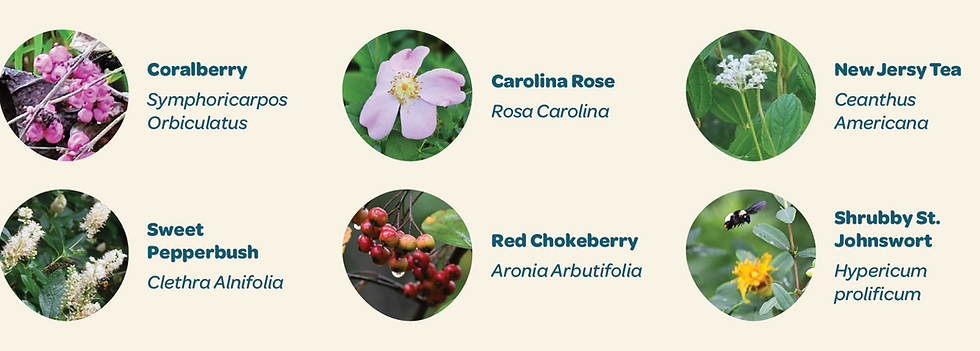
The berries and nectar from native shrubs along with the insects that have coevolved with them also serve as a food source for birds. This matters because 96% of terrestrial birds feed their babies insects. Caterpillars are the most nutritious food for birds and the insect more often fed to baby birds.

Think about the structural complexity of the landscape and create a natural, multi-layered habitat with native plants. This means having a green mulch of living plants at the ground level; a dense community of flowering plants, sedges and grasses in a variety of heights; shrubs; understory trees; and canopy trees. This kind of living landscape offers all the food, shelter, cover, and nesting sites thrashers need for survival and reproduction.

Make a plan for transitioning the landscape from non-native to native shrubs. To be clear, this doesn't mean I'm encouraging non-native shrubs as a landscape option! Adding native shrubs is always a priority. Yet, in a situation where the non-native shrubs are not invasive, it will take years for new native shrubs to offer the same kind of cover and shelter as a ten foot non-native shrub. Slowly switching to native shrubs might be a more manageable and less drastic approach.
One way to make the switch is by adding native shrubs somewhere else in the yard and cutting back or removing the non-native ones as the natives become large enough to replace them. Another idea I use is to plant native shrubs or trees next to non-native ones and continue to cut back the non-native ones as the natives grow - with the idea of eventually removing them. I've been working on making my yard all native for 15 years and I still haven't removed all the mature ornamental shrubs that form a visual and plant barrier between my yard and my neighbor's. Again, I'm not encouraging non-native plants, but addressing the reality most people face around the cost and time necessary to replace mature non-native shrubs. Nesting sites are an essential habitat support element. No matter how biodiverse the yard is, removing mature non-native, non-invasive shrubs when there aren't comparable native shrubs in place may mean birds will look for nesting real estate elsewhere - for years.

An often overlooked way to add back in nesting sites until native shrubs reach their full height is with quick growing native vines. Many birds typically nest anywhere from two to ten feet off the ground in small trees, shrubs, and vines including brown thrashers, Eastern towhees, cardinals, Carolina wrens, catbirds, mockingbirds, and American goldfinches.

Plant native shrubs that fit the space they’re in and let them express their full form so they don’t need to be constantly pruned to be shorter.

Be mindful and thoughtful about pruning shrubs. There's usually no reason for ritualistic pruning in spring just when birds are looking for nesting sites.

Although I'm focusing on shrubs as essential for brown thrasher nesting sites, supporting natural processes in place using ecologically aligned landscaping choices and practices also support a welcoming thrasher habitat and helps create a healthy ecosystem where all wildlife will thrive. Basic ways to add habitat support include:
Add a water source for wildlife that is kept clean and refreshed all year long.
Leave organic matter on the property – such as leaving the leaves, stems, stalks, seedheads, tree nuts, twigs, pinecones and bits and pieces of natural matter on the ground for wildlife and to decompose back to nourish the soil.

Make a brush pile to provide shade in summer, warmth in winter, cover from predators, nesting sites, and a food buffet of insects and small critters.
Keep cats indoors. Outdoor cats are considered an invasive species and are not part of the neighborhood ecosystem. They have an oversized negative effect on neighborhood wildlife where they have a 70% chance of successfully killing in open areas.

Keep skies dark at night by
💡Installing downward-facing fixtures
🌑Turning off lights at night
🏃♀️Using motion sensor & dimmers where light is needed
🪟Closing shades at night
💡Using warm-colored bulbs over cool white LEDs.
🌳Not using ornamental lighting to up light or downlight trees.
Don't use violent landscape tools such as gas-powered leaf blowers that are often blown into shrubs to remove leaves. Those 200mph wind can also destroy nests and any wildlife seeking shelter and cover in the shrubs.
Stay far away from yard pesticides including lawn fertilizers - we need to make our yards an insect nursery!
Note: There are no affiliate links in this blog – I enjoy the freedom that comes from speaking my mind and elevating those helping nature in some way. The highlighted text throughout the post might be references, details, explanations, worthy organizations and businesses, or examples that I think might be helpful 😊